


By Katrina Lehmann-Grube
I recently had the privilege to attend the 8th Journal of Peasant Studies (JPS) International Writeshop on Critical Agrarian Studies and Scholar-activism, hosted in Beijing and Hebei province in China. This was the 8th edition of the writeshop, which was started in 2019 to support early career researchers from the Global South with the analytical, writing, and practical skills for publishing in international journals. The writeshops are held alternately in China, hosted by the College of Humanities and Development Studies (COHD) at the China Agricultural University, and in South Africa, hosted by PLAAS, at the University of the Western Cape. These institutions, together with JPS, the Beijing Innovation Center for Rural Revitalization and Integrated Rural-urban Development, the Initiatives in Critical Agrarian Studies, the International Institute for Social Studies of Erasmus University Rotterdam in the Netherlands, and the Collective of Agrarian Scholar-Activists from the South (CASAS), form part of the collective that organise and support the workshops.
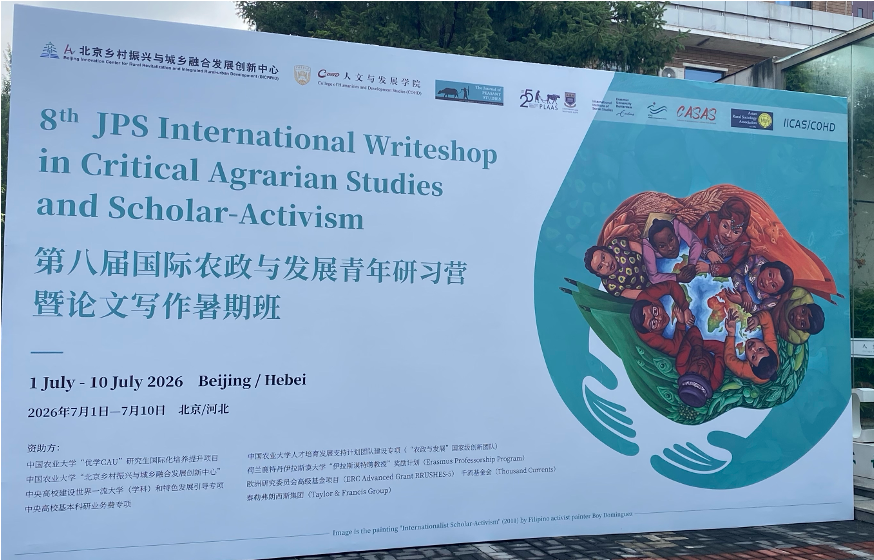
Figure 1: Photograph of the 8th Journal of Peasant Studies (JPS) International Writeshop on Critical Agrarian Studies and Scholar-activism banner by Katrina Lehmann-Grube.
This year I was one of more than 50 participants who were selected to cover the three regions of the Global South: Asia, Africa and Latin America. The writeshop brings together an amazingly diverse group of scholar-activists all working on various dimensions of critical agrarian studies, rural development and land issues. My PhD work focuses on the land dimensions of renewable energy developments in South Africa. Each participant brings a draft paper, which is reviewed during the workshop by our peers, a member of CASAS, and a JPS editor. This provides an incredible opportunity to gain insight into what editors of journals are looking for, how to strengthen our journal article writing, and get rigorous feedback from scholars working in other parts of the world.
This review process forms just one part of the writeshop’s programme. We received lectures on key theory in critical agrarian studies, and the practicalities (and injustices) of global knowledge production. Part of the writeshop was hosted in a village in Hebei province, where COHD has a 30-year research site. Here we had the opportunity to stay with local families who hosted us in their homes (and treated us to amazing food!). We got to learn about China’s radical and transformative agrarian development over the past 70 years, and what is currently being done under the new phase of Rural Revitalisation.
For many of us, this was the first time we visited China. Between hard days of work, we also got to see some of the sights – the Forbidden City, the Great Wall; and enjoy evenings together over hotpot and Beijing duck. It was incredible to be together with a group of like-minded scholars from across the Global South, and forge new connections and networks. As an alum of this programme, I have now become part of CASAS, a community of more than 400 scholars working in agrarian studies.
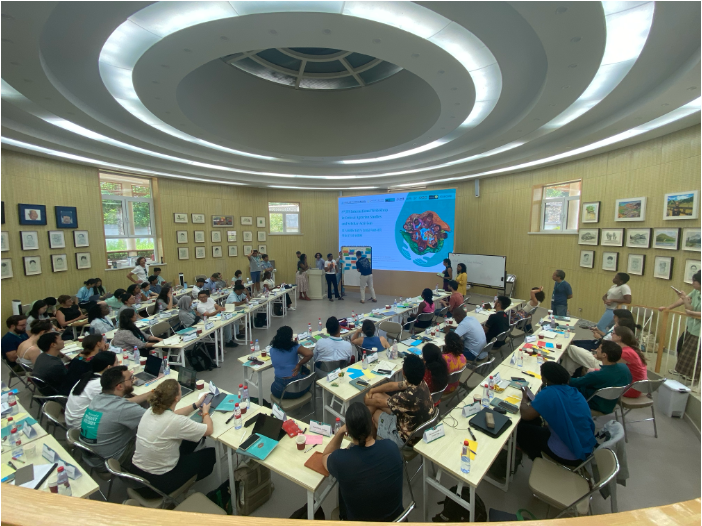
Figure 2: A writeshop session in action, captured by Katrina Lehmann-Grube.
My enormous gratitude goes out to the organisers and my fellow participants for this experience – a highlight of my academic career thus far! A special thank you to the staff and volunteers of COHD (especially Professors Jingzhong Ye and Wang Chunyu), the editors of JPS (especially Kasia Paprocki), my host in Sanggang, and Professor Jun Borras, for bringing us all together.
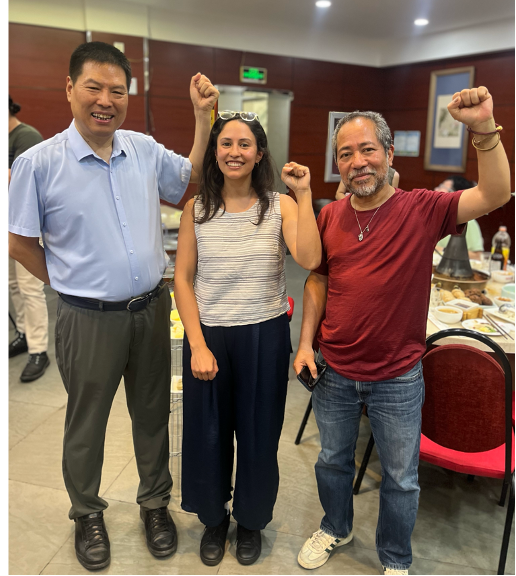
Figure 3: Katrina Lehmann-Grube (middle) with Professor Jingzhong Ye (left) and Professor Jun Borras (right)