


THE COSMOPOLITAN KAROO RESEARCH FORUM (CKRF)


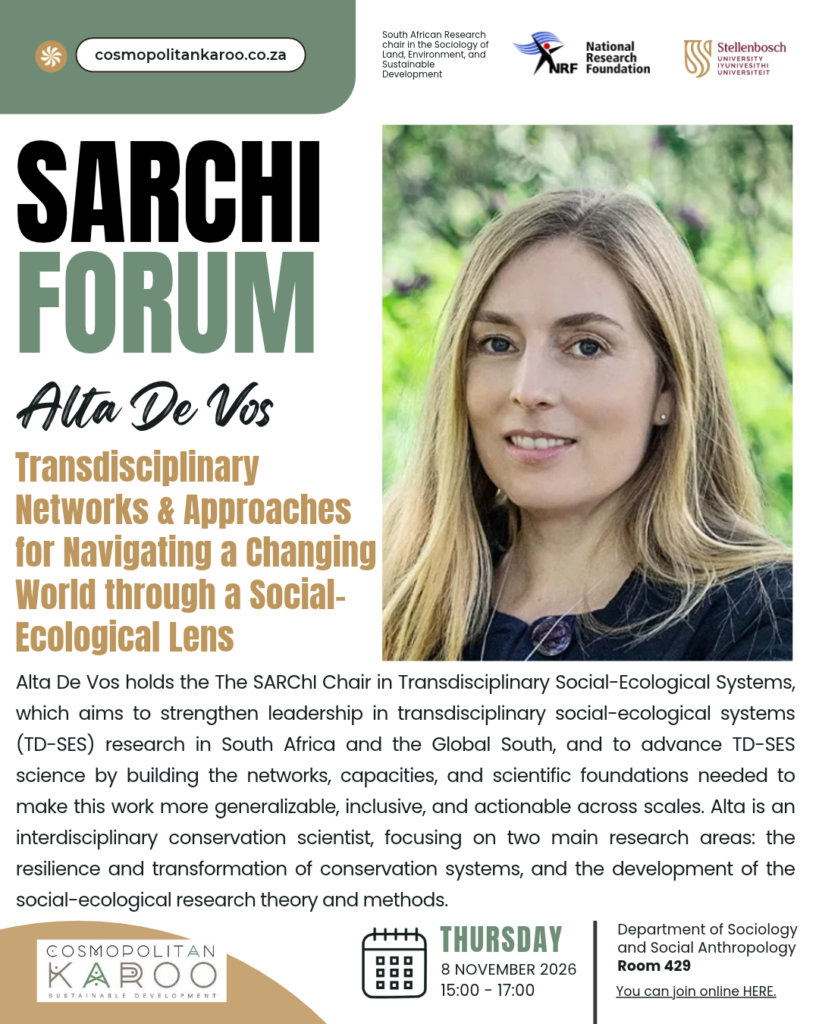
We are delighted to host Alta de Vos at our forum, who will be giving a presentation on “Transdisciplinary Networks & Approaches for Navigating a Changing World through a Social-Ecological Lens”. You can join us in person in Room 429 of the Arts and Social Sciences Building, or you can attend online via the Teams link available here. The event will take place from 15:00 to 17:00. Please find the abstract below.
We look forward to seeing you there!
Abstract:
Bending the curve on biodiversity loss, climate change and inequality calls for approaches that take seriously how deeply social and ecological systems are intertwined. Complex systems thinking shows that social-ecological systems are context-dependent, with causes that are non-linear and outcomes that are often emergent. This raises a central question: what kinds of science and knowledge do we need to inform decisions for transformative change towards just and sustainable futures? Transdisciplinary (TD) research is well placed to respond, but it is hard to sustain. It rarely has long-term institutional support, and there are few shared methods for learning across places without flattening what makes each one distinct.
In this talk I introduce the new DSI/NRF SARChI Chair in Transdisciplinary Social-Ecological Networks at Stellenbosch University. The Chair treats these gaps partially as a question of infrastructure (broadly defined): the networks, platforms, relationships and training that shape what knowledge gets produced, by whom, and for whom. It works across four linked themes:
building collaborative infrastructure through the Society for Social-Ecological Systems (SocSES), including a shared database of place-based cases; developing methods and mid-range theory for synthesising place-based knowledge; rethinking doctoral education so it is rooted in Southern contexts and TD practice; researching pathways towards just and resilient futures in multi-use landscapes, including the wildlife economy and Mega Living Landscapes.
I would welcome discussion on points of connection with the Cosmopolitan Karoo programme. Both Chairs treat places as local and globally networked at the same time, and both are interested in how land relationships and place-making shape sustainability outcomes. Both also look at how new land uses are reshaping rural landscapes and whose futures they make possible.


Forum Archive:
2026
2506: Dr. Bernard C. Moore
1106: Dr. Beatrice Bonami
0406: Student Presentations
2805: Prof. Cherryl Walker
2105: Dr. Daniel Salau Rogei
0705: Prof. Jan-Bart Gewald
3004: Dr. Eve Wong
2404: Prof. Beatriz Bustos
2603: Prof. Clemens Greiner
1903: Prof. John Parkington
1203: Prof. William Beinardt
0503: Katrina Lehmann-Grube
2502: Tapiwa Chatikobo and Prof. Ian Scoones
1902: Prof. Davide Chinigò
2025
3010: Janie Swanepoel
0910: Prof. Knut G. Nustad
0610: Prof. Michael Bollig
0210: Katrina Lehmann-Grube
2509: Stephanie Borchardt
1809: Laura J. Mitchell
2807: Dineo Skosana
2807 Matthew Wilhelm-Solomon
0506: Caroline Wallington
2905: Joëlle Chesselet
2205: Prof Davide Chinigò
1505: Prof Irus Braverman
0805: Laurin Baumgardt
2404: Chris Conz
1704: Prof Matthew Gandy
1004: Matthew Wingfield
2003: Marlene Merchert
1303: Prof William Beinart and Lizé Myburgh
0603: Prof Olaf Zenker
2702: Prof Nigel Penn