


By Stephanie Borchardt
I recently spent four days, from 24 to 27 August 2026, in Odense, Denmark, for the COM-PRES workshop hosted by the University of Southern Denmark (SDU). COM-PRES (Communities and the Private Renewable Energy Sector) brings together researchers from South Africa, Italy, and Denmark to examine a deceptively simple question: why do the community benefits promised by renewable energy projects vary so dramatically from one place to another?
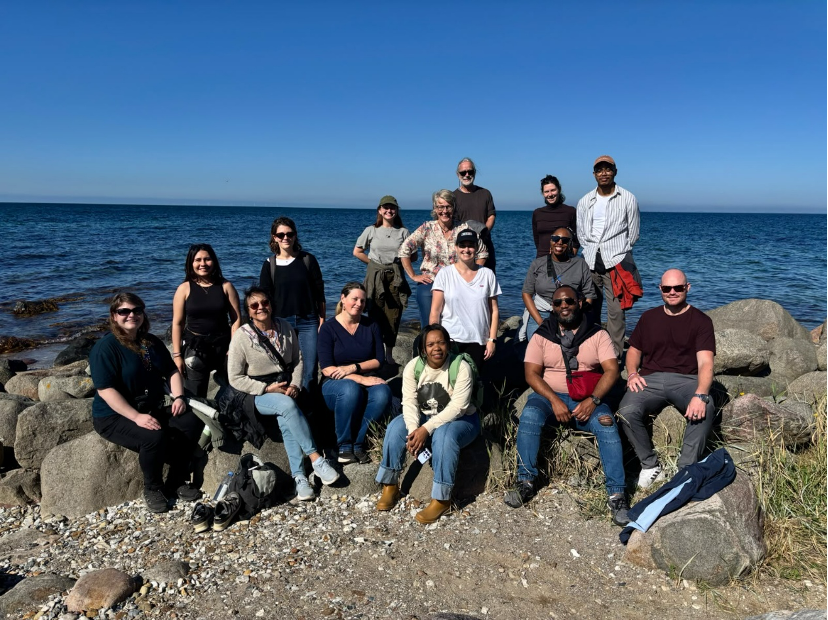
Figure 1: Group Photograph
It is a question that has also followed my own fieldwork on South Africa’s Renewable Energy Independent Power Producer Procurement Programme (REIPPPP), so the workshop felt less like their research project update and more like a shared attempt to understand what makes an energy transition work, or fail, at the various levels.
My own presentation at the workshop focused on renewable energy, jobs and local economies in Sutherland, a small Karoo town in the Northern Cape province. It drew on new fieldwork and my recent paper, Dust in the wind: Renewable energy and the limits of South Africa’s developmental state, published in New Agenda. See here: https://journals.co.za/doi/10.14426/na.v99i1.3197
REIPPPP has been remarkably successful at attracting private investment into South Africa’s renewable energy sector. But its market-driven design also shifts much of the responsibility for socioeconomic transformation from the state to private companies. In Sutherland, this has produced jobs that are real but largely temporary and low-skilled, a construction boom that briefly transformed the local tourism economy but has since collapsed, and accountability spread so widely between government, developers, contractors, sub-contractors, and municipalities that it becomes difficult to establish who is ultimately responsible.
That question of responsibility became even sharper during Tuesday’s discussions on just transitions in the Global North.
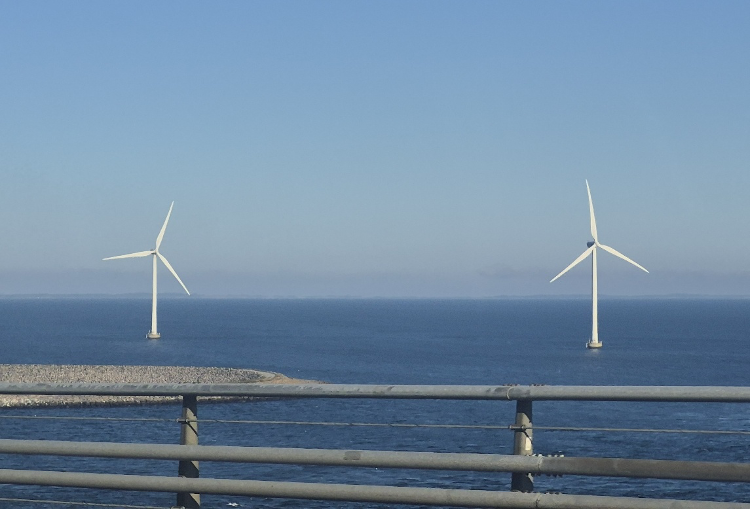
Figure 2: Offshore wind farm, Great Belt Bridge. Photograph by SP Borchardt, Aug 2026
Lars Tønder spoke about Danish renewable energy projects where communities are brought into decision-making early, rather than being consulted after the important decisions have already been made. Rune Bennike challenged the assumption that a just transition is simply a matter of replacing old jobs with new ones. In reality, skills, incomes and communities can erode long before anything arrives to replace them. Research by Vincent Keating and Dikte Reeh Andersen on young Danish farmers added another dimension: even in a relatively well-resourced agricultural system, young people are increasingly uncertain whether farming has a future.
I kept thinking about Komati.
The Eskom coal plant near Middelburg was the first major power station to close under South Africa’s just transition agenda. It has also become something of a cautionary tale. Contractors were appointed late, only a fraction of workers were retrained, and the local economy lost an economic base that had sustained it for decades. The Presidential Climate Commission’s review pointed to poor sequencing, fragmented planning and inadequate engagement with workers and communities.
A $497 million World Bank grant was intended to support retraining and economic repurposing. But the problem was never simply whether enough jobs or training places were counted. The deeper question was who had the power to shape what happened to the workers and communities whose lives were being reorganised.
That is what stayed with me from Bennike’s argument: a just transition is not about replacing one set of jobs with another. It is about power, institutions and the social relationships through which energy systems are built and dismantled. Perhaps the bigger lesson I brought home from Denmark: transitions are never only about changing technologies. They are about places, livelihoods, institutions and who gets to decide what happens next.
Of course, there was also time for some fun. Between sessions, we visited Trelleborg, one of Denmark’s best-preserved Viking ring fortresses, built around 980 AD by King Harald Bluetooth.
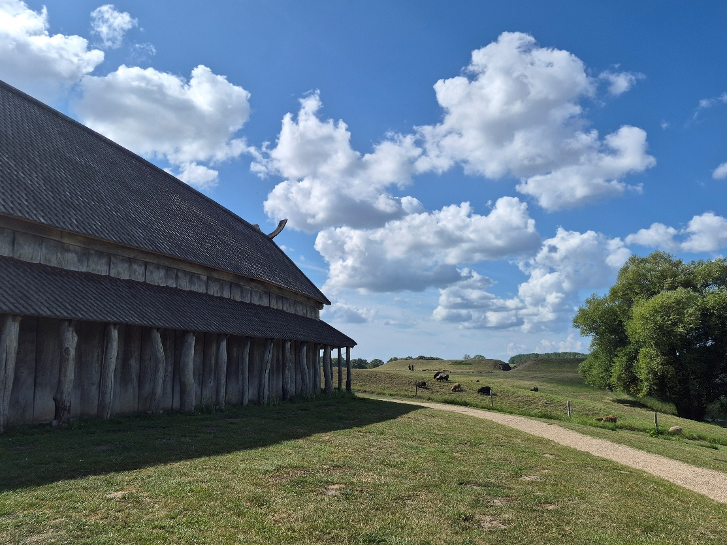
Figure 3: A reconstructed Viking longhouse in Trelleborg. Photograph by SP Borchardt, Aug 2026
In 1997, Bluetooth technology borrowed his name and symbol, supposedly because he united Scandinavian tribes in much the same way the technology was intended to unite devices. We ended the day with hotdogs by the harbour. Danes take their hotdogs seriously. They are also very good.
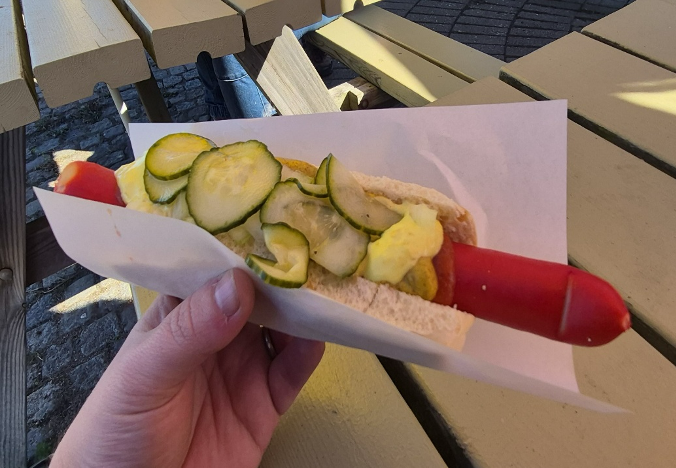
Figure 4: Danish hotdog with a red sausage (rød pølse). Photograph by SP Borchardt, Aug 202
My thanks to the University of Southern Denmark (SDU), particularly the Department of Political Science and Public Management, for inviting me to present my work and for the opportunity to learn from scholars working on energy transitions across very different contexts. I returned home with new questions, new perspectives, and, of course, a new appreciation for Danish hotdogs.